

When Do Piles Need Surgery?
Piles are incredibly common and the good news is that most cases never require surgery. But there are situations where conservative treatments simply are not enough, and surgery becomes the most effective path to lasting relief. Understanding where your condition stands can help you make informed decisions without unnecessary anxiety.
Not Every Case of Piles Ends in Surgery But Some Do
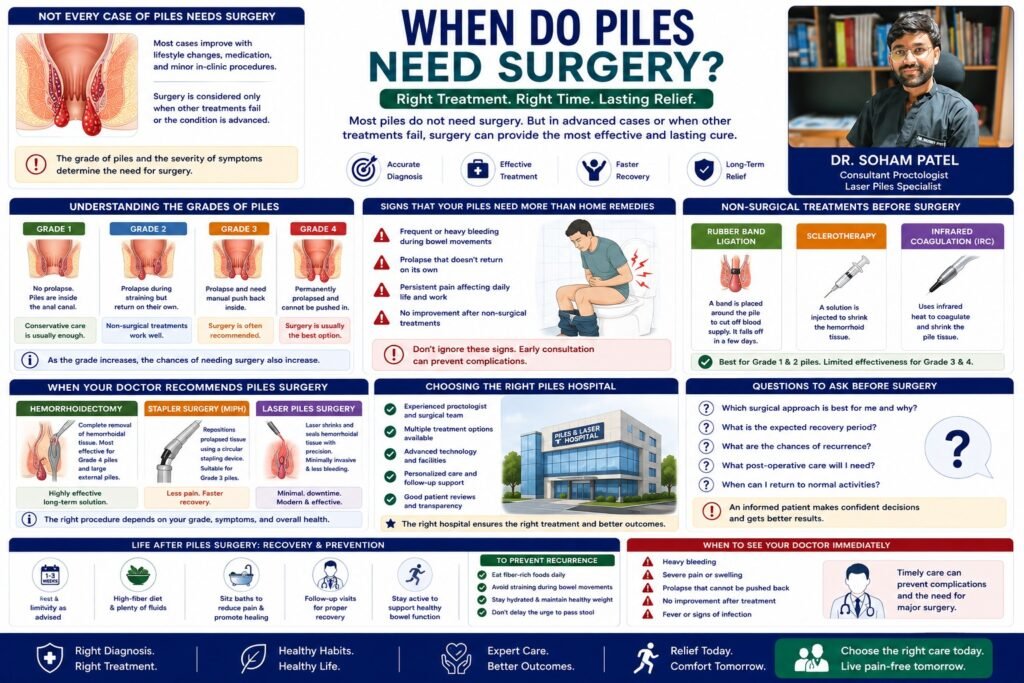
The majority of people with hemorrhoids manage their condition successfully through dietary changes, hydration, topical treatments, and minor in-clinic procedures. Surgery is typically considered only when these approaches have been tried and have not delivered lasting results or when the condition has progressed to a stage where simpler treatments are no longer appropriate.
What Actually Determines Whether Surgery Is Necessary
Two key factors drive this decision the grade of your piles and the severity of your symptoms. A specialist will evaluate both before recommending any surgical intervention.
Understanding the Grades of Piles The Foundation of Every Decision
Piles are classified into four grades based on how far they have progressed:
Grade 1 and Grade 2 When Conservative Care Is Enough
Grade 1 piles are small swellings inside the anal canal with no prolapse. Grade 2 piles prolapse during straining but return on their own. Both grades respond well to lifestyle changes, medications, and non-surgical procedures. Surgery is rarely needed at this stage.
Grade 3 and Grade 4 When Surgery Enters the Picture
Grade 3 piles prolapse and need to be manually pushed back. Grade 4 piles are permanently prolapsed and cannot be repositioned. At these stages, non-surgical treatments often provide only temporary relief and piles surgery becomes a genuine and often necessary consideration.
Signs That Your Piles Are Moving Beyond Home Remedies
Even before grading, certain symptoms indicate that your condition needs more than self-care:
- Frequent or heavy bleeding during bowel movements that does not respond to dietary changes
- Prolapse that no longer returns on its own or requires manual repositioning every time
- Persistent pain that is affecting your ability to sit, work, or move comfortably
- No improvement after non-surgical treatments like rubber band ligationor sclerotherapy
If you are experiencing any of these, it is time to have an honest conversation with your specialist about surgical options.
Non-Surgical Treatments That Come Before Surgery
Before recommending surgery, most specialists will explore non-surgical procedures:
- Rubber Band Ligation— Places a band around the pile to cut off blood supply
- Sclerotherapy— Injects a solution to shrink the hemorrhoid tissue
- IRC (Infrared Coagulation)— Uses heat to coagulate and shrink the pile
These work well for Grade 1 and Grade 2 hemorrhoids but have limited effectiveness for Grade 3 and Grade 4 cases where tissue prolapse is significant.
When Your Doctor Recommends Piles Surgery What It Means
If non-surgical options have not worked or your grade warrants it, your doctor may recommend one of the following:
Hemorrhoidectomy – Complete Removal for Advanced Cases
A hemorrhoidectomy is the surgical removal of pile tissue. It is the most effective long-term solution for Grade 4 piles and large external hemorrhoids. Recovery takes a few weeks but the success rate is consistently high.
Stapler Surgery (MIPH) — Minimally Invasive for Grade 3
Stapler surgery repositions prolapsed internal pile tissue using a circular stapling device. It involves less post-operative pain than a traditional hemorrhoidectomy and allows for faster return to daily activities.
Laser Piles Surgery – Precision With Minimal Downtime
Laser piles surgery uses a focused laser beam to shrink and seal hemorrhoidal tissue with pinpoint accuracy. It involves minimal bleeding, no large incisions, and significantly faster recovery making it an increasingly preferred option for patients seeking a modern, minimally invasive approach.
Choosing the Right Piles Hospital Why It Matters
The facility and specialist you choose play a significant role in your surgical outcome. When evaluating a piles hospital, consider:
- The surgeon’s experience specifically with anorectal procedures
- Availability of multiple surgical options not just one approach
- Post-operative care and follow-up protocols
- Patient reviews and transparency around recovery expectations
Questions to Ask Before Agreeing to Surgery
- Which surgical approach is recommended for my specific grade and why?
- What is the expected recovery period?
- What are the chances of recurrence after this procedure?
- What post-operative support does the hospital provide?
Being an informed patient leads to better outcomes always.
Life After Piles Surgery Recovery and Prevention
Recovery after piles surgery varies by procedure but generally involves:
- 1 to 3 weeks of rest and restricted activity depending on the surgical method
- A high-fibre diet and adequate hydration to ensure smooth bowel movements during healing
- Sitz baths to reduce discomfort and promote healing around the surgical site
- Regular follow-up visits with your specialist to monitor recovery
To prevent hemorrhoids from returning after surgery:
- Maintain a consistently fiber-rich diet
- Never strain during bowel movements
- Stay physically active to support healthy bowel function
- Respond promptly to the urge to pass stool never delay it
Surgery Is Not the End. It Is Often the Beginning of Real Relief
For many patients, piles surgery is the turning point after months or even years of discomfort. It is not something to fear it is something to understand. Whether your condition calls for a hemorrhoidectomy, stapler surgery, or laser treatment, the right piles hospital and the right specialist will guide you through the process with clarity and care. The goal is not just to treat the condition it is to give you your quality of life back.