

Internal vs External Piles: How to Tell the Difference?
Piles medically known as hemorrhoids are one of the most common yet least discussed health concerns. Many people live with the discomfort for months before seeking help, often because they are unsure what type they have or how serious it is. Understanding the difference between internal and external piles is the first step toward getting the right care.
What Are Piles and Why Do They Develop?
Piles are swollen veins in and around the rectum and anal canal. They develop when increased pressure from chronic constipation, prolonged straining, pregnancy, or a low-fibre diet causes these veins to swell and become inflamed.
The Anatomy Behind Piles:
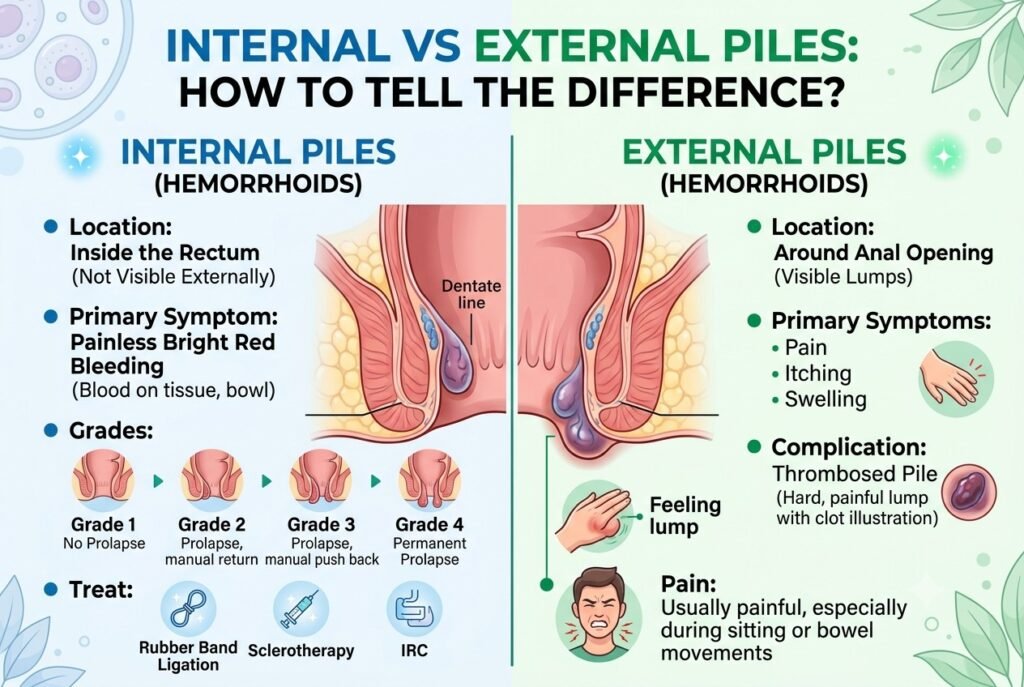
The location of the swelling determines the type. Piles that form inside the rectum are called internal piles. Those that develop around the outer anal opening are called external piles. Both share common causes but differ significantly in symptoms, appearance, and treatment approach.
Internal Piles - What Happens Inside the Rectum?
Internal piles develop within the lining of the rectum and are typically not visible or directly felt in early stages.
Symptoms You Feel But Cannot See:
The most common sign is painless bright red bleeding during bowel movements. You may notice blood on tissue paper or in the bowl. A feeling of incomplete evacuation or mild discomfort after passing stool is also common.
The Four Grades of Internal Piles:
Internal piles are classified into four grades based on severity:
- Grade 1— Small swellings inside the anal canal; no prolapse
- Grade 2— Prolapse during straining but return on their own
- Grade 3— Prolapse and require manual pushing back
- Grade 4— Permanently prolapsed and cannot be pushed back
Grade determines which piles treatment option your doctor will recommend.
External Piles - What Develops Around the Anal Opening
External piles form under the skin around the anal opening and are often visible and painful.
Symptoms That Are Visible and Uncomfortable:
Unlike internal piles, external piles cause itching, swelling, and pain especially during sitting or bowel movements. In some cases, a hard, tender lump forms when a blood clot develops inside this is called a thrombosed external pile and can be extremely painful, requiring prompt medical attention.
Piles Treatment Options - Based on Type and Grade
|
Sr.
|
Feature
|
Internal Piles
|
External Piles
|
|---|---|---|---|
|
1
|
Location
|
Inside rectum
|
Around anal opening
|
|
2
|
Pain
|
Usually painless
|
Often painful
|
|
3
|
Bleeding
|
Common
|
Less Common
|
|
4
|
Visibility
|
Not visible
|
Visible as lumps
|
|
5
|
Prolapse
|
Possible in Grade 2–4
|
Does not prolapse
|
Piles Treatment Options - Based on Type and Grade
Treatment is never one-size-fits-all. It depends on the type, grade, and severity of your piles.
Non-Surgical Treatments for Mild to Moderate Cases:
For Grade 1 and Grade 2 internal piles, non-surgical procedures are usually sufficient:
- Rubber Band Ligation– A small rubber band is placed around the pile to cut off its blood supply, causing it to shrink and fall off naturally
- Sclerotherapy– A chemical solution is injected directly into the pile to shrink it
- IRC (Infrared Coagulation)– Infrared heat is used to coagulate the blood vessels feeding the pile, effectively shrinking it with minimal discomfort
Minimally Invasive Surgical Options:
For Grade 3 piles or cases that do not respond to non-surgical treatment:
- Laser Piles Treatment– A precise laser beam closes off the hemorrhoidal tissue with minimal bleeding, faster healing, and significantly less post-operative pain compared to traditional surgery
- MIPH / Stapler Surgery– A circular stapling device repositions and removes the prolapsed internal pile tissue, restoring normal anatomy with minimal discomfort and quick recovery
Conventional Surgery for Advanced Cases
Hemorrhoidectomy – Complete surgical removal of the pile tissue. Recommended for Grade 4 internal piles or large, complex external piles that do not respond to other treatments. It has the highest long-term success rate among all surgical options
How Does Your Doctor Decide the Right Treatment?
Your specialist will consider the grade and type of piles, your symptoms, age, overall health, and personal preferences before recommending a treatment path. Always ask:
- Which grade are my piles?
- Is surgery necessary or can we start with a non-surgical option?
- What is the expected recovery time?
Being informed makes a significant difference in the quality of care you receive.
Prevention - Keeping Piles from Returning:
Regardless of the treatment you choose, these habits protect your long-term rectal health:
- Eat a high-fibre diet with fruits, vegetables, and whole grains
- Drink plenty of water daily to keep stools soft
- Never strain during bowel movements
- Avoid sitting on the toilet for extended periods
- Exercise regularly to improve bowel function
Final Thoughts - Know Your Type, Get the Right Care
Internal and external piles may share the same root cause but they behave differently, feel different, and require different approaches to treatment. Whether your case calls for rubber band ligation, sclerotherapy, laser treatment for piles, stapler surgery, or a hemorrhoidectomy the right diagnosis always comes first. Do not delay speaking to a specialist. The sooner you understand what you are dealing with, the sooner you can put it behind you.