Uncategorized

Uncategorized

How to Stop Hemorrhoids from Coming Back?

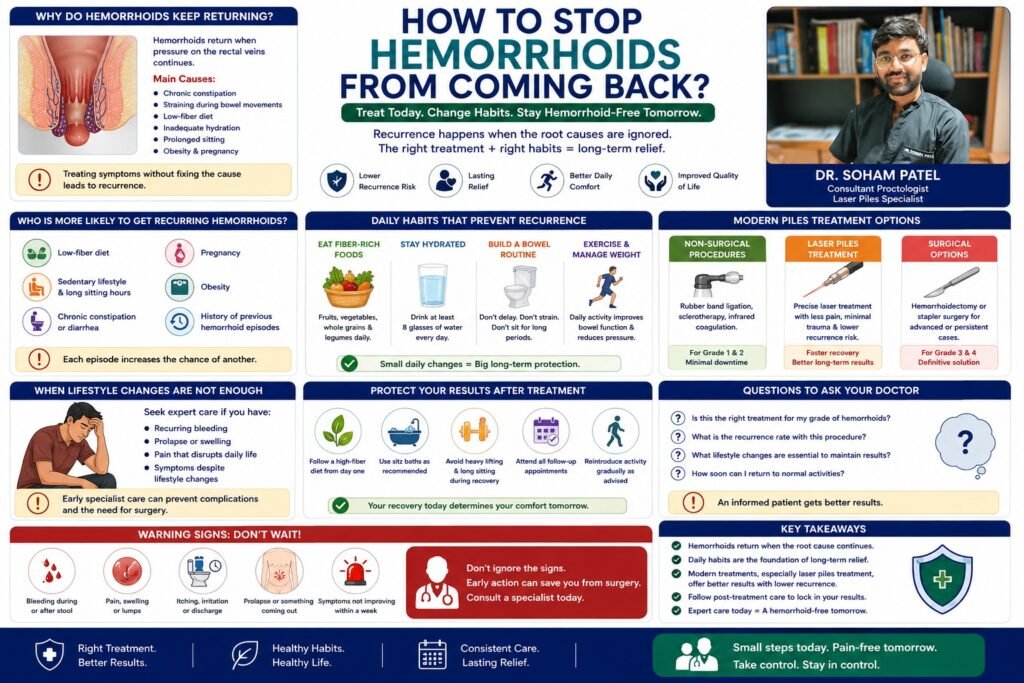
How to Stop Hemorrhoids from Coming Back? Dealing with hemorrhoids once is frustrating enough. Dealing with them repeatedly is exhausting and unfortunately, very common. The truth is that most recurrences happen not because the treatment failed, but because the underlying causes were never fully addressed. Understanding why they come back is the first step toward making sure they do not. Why Do Hemorrhoids Keep Returning After Treatment? Many people treat the symptoms and move on without changing the habits that caused the problem in the first place. Hemorrhoids develop when increased pressure on the veins in the rectal and anal area causes them to swell. If that pressure is never relieved, the swelling will return regardless of how effective the initial treatment was. The Root Causes Most People Never Address Chronic constipation, prolonged straining, a low-fiber diet, inadequate hydration, and long hours of sitting are the most common drivers of recurring hemorrhoids. These are lifestyle patterns and without changing them, recurrence is almost inevitable. Who Is More Likely to Get Recurring Hemorrhoids? Some people are at higher risk of repeat episodes than others. Knowing your risk profile helps you take prevention more seriously. Lifestyle and Medical Factors That Increase Risk A consistently low-fiber diet that produces hard, difficult-to-pass stools Sedentary lifestyle with prolonged sitting especially desk jobs Chronic constipation or diarrhea that puts repeated pressure on anal veins Pregnancy due to increased abdominal pressure on rectal veins Obesity excess body weight increases pressure on the pelvic region A history of previous hemorrhoid episodes each recurrence slightly increases the likelihood of another Daily Habits That Form the Foundation of Prevention No treatment surgical or otherwise works in isolation. Long-term prevention depends on daily habits that reduce pressure on the rectal veins consistently. Fiber, Hydration, and Bowel Routine The Non-Negotiable Trio A high-fibre diet keeps stools soft and reduces the need to strain. Aim for fruits, vegetables, legumes, and whole grains daily. Pair this with adequate water intake at least 8 glasses per day to keep the digestive system moving smoothly. Why Your Toilet Habits Matter More Than You Think? Avoid spending extended time on the toilet. Do not delay the urge to pass stool  holding it in leads to harder stools and more straining. Never force a bowel movement. These small adjustments have a surprisingly significant impact on recurrence risk. Exercise and Weight Management Regular physical activity improves bowel function and reduces pelvic pressure. Even a 20 to 30 minute walk daily can make a measurable difference in both prevention and recovery from hemorrhoids. When Lifestyle Changes Are Not Enough If your hemorrhoids keep returning despite consistent lifestyle adjustments, your body is telling you that it needs more targeted medical intervention. Recurring bleeding, prolapse, or pain that disrupts daily life are signs that home management has reached its limit. Modern Piles Treatment Options That Address Recurrence at the Root The right piles treatment does more than provide temporary relief it addresses the structural problem to reduce the likelihood of recurrence. Non-Surgical Procedures for Mild to Moderate Cases For Grade 1 and Grade 2 hemorrhoids, procedures like rubber band ligation, sclerotherapy, and infrared coagulation can effectively shrink hemorrhoidal tissue with minimal downtime. These are performed in a clinic setting and require no general anaesthesia. Laser Piles Treatment Precision That Reduces Recurrence Risk Laser piles treatment uses a focused laser beam to seal and destroy hemorrhoidal tissue with exceptional precision. Unlike conventional procedures, it causes minimal trauma to surrounding tissue, results in significantly less post-operative discomfort, and carries a lower recurrence rate when combined with proper lifestyle changes. It is increasingly the preferred choice for patients who want effective treatment with faster recovery and reduced risk of the problem returning. Surgical Options for Persistent or Advanced Cases For Grade 3 and Grade 4 hemorrhoids that have not responded to other treatments, surgical options like hemorrhoidectomy or stapler surgery offer a more definitive solution. These procedures remove or reposition the hemorrhoidal tissue completely and are recommended when recurrence has become a chronic pattern. Protecting Your Results After Treatment The period immediately following any piles treatment is critical. What you do during recovery directly influences whether your results last. Post-Treatment Habits That Lock In Long-Term Results Follow a high-fiber diet from day one of recovery do not wait until symptoms return Use sitz baths as recommended to promote healing and reduce inflammation    Avoid heavy lifting and prolonged sitting during the recovery window Attend all follow-up appointments do not skip them even if you feel fine Reintroduce physical activity gradually as advised by your specialist Questions to Ask Your Doctor Before Starting Treatment Being an informed patient leads to better outcomes. Before committing to any treatment plan, ask: Is this the right treatment for my specific grade of hemorrhoids? What is the recurrence rate associated with this procedure? What lifestyle changes are essential to maintain results after treatment? How soon can I return to normal daily activities? Hemorrhoids Can Be Stopped. But It Takes More Than One Step Recurring hemorrhoids are not inevitable they are preventable. Whether you are managing a mild case with lifestyle changes, exploring non-surgical piles treatment, or considering laser piles treatment for a more lasting solution, the key is consistency. Treat the condition properly, change the habits that caused it, and follow through on post-treatment care. That combination is what actually stops hemorrhoids from coming back.  

Uncategorized

When Do Piles Need Surgery?

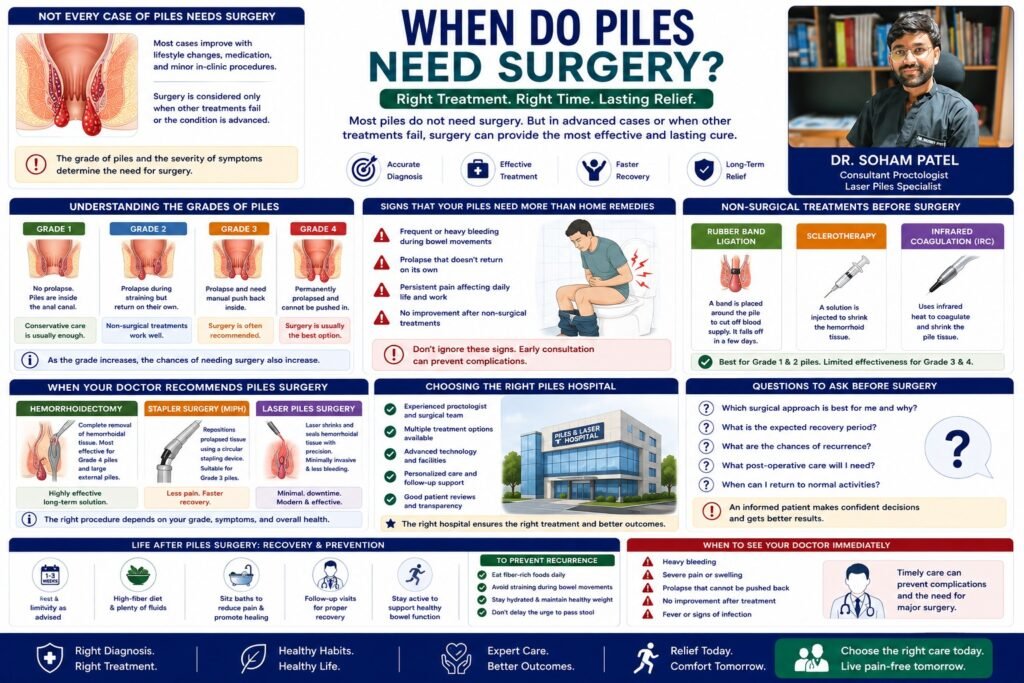
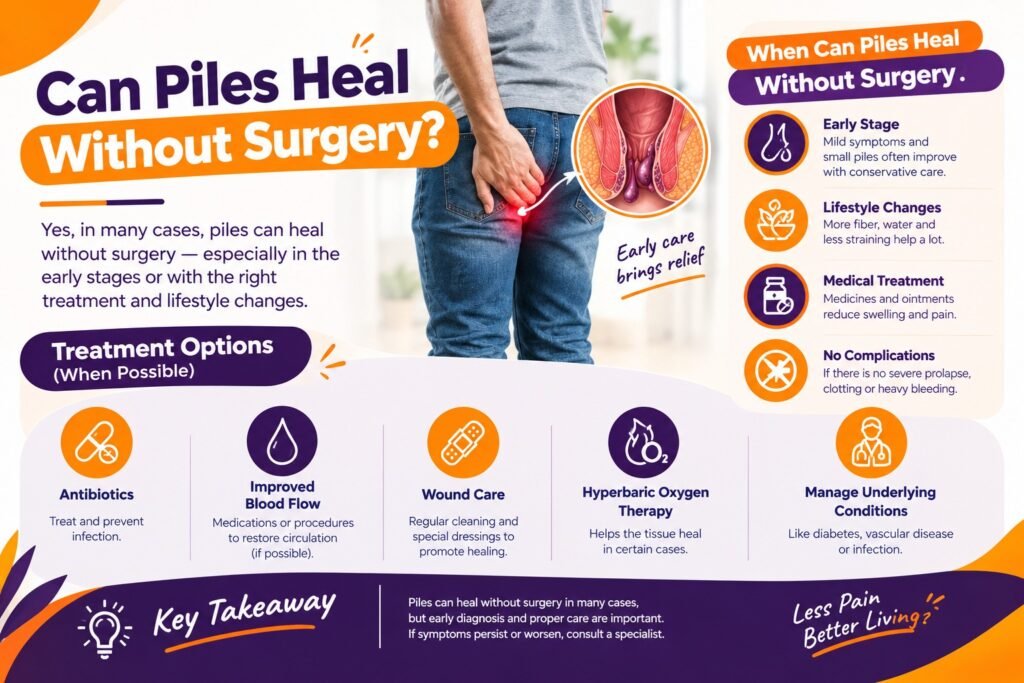
When Do Piles Need Surgery? Piles are incredibly common and the good news is that most cases never require surgery. But there are situations where conservative treatments simply are not enough, and surgery becomes the most effective path to lasting relief. Understanding where your condition stands can help you make informed decisions without unnecessary anxiety. Not Every Case of Piles Ends in Surgery But Some Do The majority of people with hemorrhoids manage their condition successfully through dietary changes, hydration, topical treatments, and minor in-clinic procedures. Surgery is typically considered only when these approaches have been tried and have not delivered lasting results or when the condition has progressed to a stage where simpler treatments are no longer appropriate. What Actually Determines Whether Surgery Is Necessary Two key factors drive this decision the grade of your piles and the severity of your symptoms. A specialist will evaluate both before recommending any surgical intervention. Understanding the Grades of Piles The Foundation of Every Decision Piles are classified into four grades based on how far they have progressed: Grade 1 and Grade 2 When Conservative Care Is Enough Grade 1 piles are small swellings inside the anal canal with no prolapse. Grade 2 piles prolapse during straining but return on their own. Both grades respond well to lifestyle changes, medications, and non-surgical procedures. Surgery is rarely needed at this stage. Grade 3 and Grade 4 When Surgery Enters the Picture Grade 3 piles prolapse and need to be manually pushed back. Grade 4 piles are permanently prolapsed and cannot be repositioned. At these stages, non-surgical treatments often provide only temporary relief and piles surgery becomes a genuine and often necessary consideration. Signs That Your Piles Are Moving Beyond Home Remedies Even before grading, certain symptoms indicate that your condition needs more than self-care: Frequent or heavy bleeding during bowel movements that does not respond to dietary changes Prolapse that no longer returns on its own or requires manual repositioning every time Persistent pain that is affecting your ability to sit, work, or move comfortably No improvement after non-surgical treatments like rubber band ligationor sclerotherapy If you are experiencing any of these, it is time to have an honest conversation with your specialist about surgical options. Non-Surgical Treatments That Come Before Surgery Before recommending surgery, most specialists will explore non-surgical procedures: Rubber Band Ligation— Places a band around the pile to cut off blood supply Sclerotherapy— Injects a solution to shrink the hemorrhoid tissue IRC (Infrared Coagulation)— Uses heat to coagulate and shrink the pile These work well for Grade 1 and Grade 2 hemorrhoids but have limited effectiveness for Grade 3 and Grade 4 cases where tissue prolapse is significant. When Your Doctor Recommends Piles Surgery What It Means If non-surgical options have not worked or your grade warrants it, your doctor may recommend one of the following: Hemorrhoidectomy – Complete Removal for Advanced Cases A hemorrhoidectomy is the surgical removal of pile tissue. It is the most effective long-term solution for Grade 4 piles and large external hemorrhoids. Recovery takes a few weeks but the success rate is consistently high. Stapler Surgery (MIPH) — Minimally Invasive for Grade 3 Stapler surgery repositions prolapsed internal pile tissue using a circular stapling device. It involves less post-operative pain than a traditional hemorrhoidectomy and allows for faster return to daily activities. Laser Piles Surgery – Precision With Minimal Downtime Laser piles surgery uses a focused laser beam to shrink and seal hemorrhoidal tissue with pinpoint accuracy. It involves minimal bleeding, no large incisions, and significantly faster recovery making it an increasingly preferred option for patients seeking a modern, minimally invasive approach.   Choosing the Right Piles Hospital Why It Matters The facility and specialist you choose play a significant role in your surgical outcome. When evaluating a piles hospital, consider: The surgeon’s experience specifically with anorectal procedures Availability of multiple surgical options not just one approach Post-operative care and follow-up protocols Patient reviews and transparency around recovery expectations Questions to Ask Before Agreeing to Surgery Which surgical approach is recommended for my specific grade and why? What is the expected recovery period? What are the chances of recurrence after this procedure? What post-operative support does the hospital provide? Being an informed patient leads to better outcomes always. Life After Piles Surgery Recovery and Prevention Recovery after piles surgery varies by procedure but generally involves: 1 to 3 weeks of rest and restricted activity depending on the surgical method A high-fibre diet and adequate hydration to ensure smooth bowel movements during healing Sitz baths to reduce discomfort and promote healing around the surgical site Regular follow-up visits with your specialist to monitor recovery To prevent hemorrhoids from returning after surgery: Maintain a consistently fiber-rich diet Never strain during bowel movements Stay physically active to support healthy bowel function Respond promptly to the urge to pass stool never delay it Surgery Is Not the End. It Is Often the Beginning of Real Relief For many patients, piles surgery is the turning point after months or even years of discomfort. It is not something to fear it is something to understand. Whether your condition calls for a hemorrhoidectomy, stapler surgery, or laser treatment, the right piles hospital and the right specialist will guide you through the process with clarity and care. The goal is not just to treat the condition it is to give you your quality of life back.

Uncategorized

10 Foods to Avoid In Piles

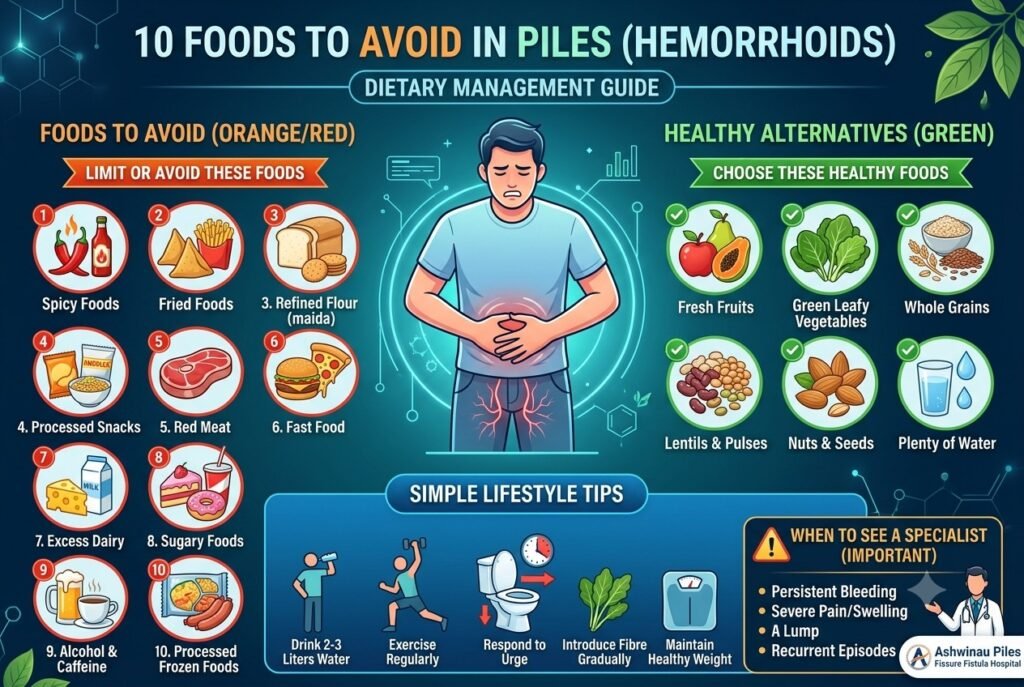
10 Foods to Avoid In Piles Piles, also known as hemorrhoids, are swollen veins in the lower rectum or anus that can cause pain, itching, bleeding, and discomfort during bowel movements. While medical treatment may be necessary in some cases, your daily eating habits can significantly influence your symptoms. Certain foods may increase constipation, strain during bowel movements, or irritate the digestive tract, making piles more uncomfortable. Knowing which foods to limit or avoid can help reduce flare-ups and support smoother bowel movements. In this article, we’ll discuss 10 foods to avoid in piles and healthier alternatives that promote better digestive health. Why Does Diet Matter in Piles? A balanced diet rich in fibre and fluids helps keep stools soft, reducing pressure on the veins around the anus. On the other hand, foods low in fibre or high in unhealthy fats can contribute to constipation, making bowel movements difficult and painful. Although dietary changes cannot cure every case of piles, they are an essential part of managing symptoms and preventing recurrence. 10 Foods to Avoid In Piles Spicy FoodsChillies and heavily spiced dishes may not directly cause piles, but they can worsen burning, irritation, and discomfort during bowel movements in some individuals. If you notice symptoms becoming worse after eating spicy foods, it is best to reduce their intake. Fried FoodsDeep-fried snacks such as samosas, pakoras, chips, and French fries are often high in unhealthy fats and low in fibre. These foods slow digestion, increase constipation, and may make passing stools more difficult. Refined Flour (Maida) ProductsWhite bread, pizza, burgers, pastries, biscuits, and other maida-based foods contain very little fibre. Frequent consumption can contribute to harder stools and increase straining during bowel movements. Processed and Packaged SnacksPackaged chips, instant noodles, crackers, and ready-to-eat snacks are often high in sodium and preservatives while lacking dietary fibre. Regular intake may negatively affect digestive health and increase constipation. Red MeatRed meat takes longer to digest than plant-based protein sources. Eating it in large quantities may slow bowel movements and increase the risk of constipation, especially when fibre intake is low. Fast FoodBurgers, pizzas, fried chicken, and similar fast foods are usually high in unhealthy fats and refined carbohydrates while being low in fibre. Replacing these meals with home-cooked, fibre-rich foods supports better digestive health. Excess Dairy ProductsLarge amounts of cheese, full-fat milk, and ice cream may contribute to constipation in some people. If dairy seems to worsen your symptoms, consider consuming it in moderation while maintaining adequate fibre intake. Sugary Foods and Soft DrinksCakes, chocolates, candies, sugary beverages, and desserts provide excess sugar but little nutritional value. Overconsumption may affect gut health and often replaces healthier, fibre-rich food choices. Alcohol and Excess CaffeineAlcohol can contribute to dehydration, while consuming excessive amounts of coffee or caffeinated beverages may also reduce hydration in some individuals. Inadequate water intake can lead to harder stools, making piles symptoms worse. Highly Processed Frozen FoodsFrozen meals, processed meats, sausages, and similar convenience foods often contain high levels of sodium and preservatives with minimal fibre. These foods should be limited if you’re trying to improve bowel health. What Should You Eat Instead? Rather than focusing only on foods to avoid, include more foods that support healthy digestion. Choose foods such as: Fresh fruits like apples, pears, papaya, and guava Green leafy vegetables Whole grains like oats and brown rice Lentils and pulses Nuts and seeds in moderation Plenty of water throughout the day A fibre-rich diet helps soften stools, making bowel movements easier and reducing strain on the affected veins. Simple Lifestyle Tips to Manage Piles Diet works best when combined with healthy lifestyle habits. You can reduce the risk of worsening piles by: Drinking 2–3 litres of water daily Exercising regularly to support bowel movements Avoiding prolonged sitting on the toilet Responding promptly to the urge to pass stool Including fibre gradually in your meals Maintaining a healthy body weight These simple habits can make a noticeable difference in your digestive health over time. When Should You See a Specialist? Dietary changes can help relieve mild symptoms, but they may not be enough if piles become severe or keep returning. You should consult piles specialist if you experience: Persistent bleeding during bowel movements Severe pain or swelling around the anus A lump that does not improve Recurrent episodes of piles Symptoms lasting despite dietary and lifestyle changes At Ashwinau Piles Fissure Fistula Hospital, patients receive a thorough evaluation to identify the underlying cause of their symptoms. Depending on the severity of the condition, treatment may range from conservative management to advanced minimally invasive procedures designed for faster recovery and improved comfort. Healthy Food Choices Can Help Manage Piles Knowing the foods to avoid in piles is an important step toward managing symptoms and preventing future flare-ups. Limiting processed, fried, spicy, and low-fibre foods while choosing a balanced, fibre-rich diet can help improve bowel health and reduce discomfort. However, if your symptoms persist despite dietary improvements, seeking timely medical advice is essential. Early diagnosis and appropriate treatment can help you recover comfortably and prevent complications.

Uncategorized

7 Early Signs of Piles You Should Never Ignore

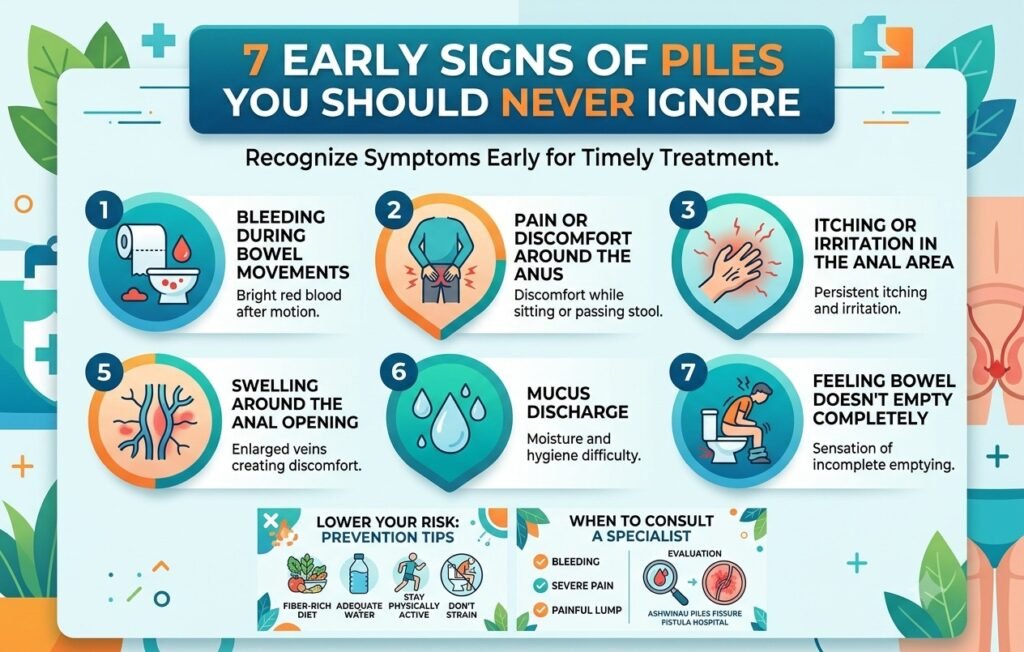
7 Early Signs of Piles You Should Never Ignore Piles, also known as hemorrhoids, are a common condition that affects people of all ages. They develop when the veins in the lower rectum or anus become swollen due to increased pressure, often caused by chronic constipation, prolonged sitting, pregnancy, or frequent straining during bowel movements. While piles are usually treatable, many people ignore the early warning signs because they feel embarrassed or assume the symptoms will go away on their own. Recognising the symptoms early can help prevent the condition from worsening and allow timely treatment. Here are 7 early signs of piles you should never ignore. Why Recognising Piles Symptoms Early Matters In the initial stages, piles may cause only mild discomfort, making them easy to overlook. However, delaying treatment can lead to increased pain, persistent bleeding, larger swollen veins, and complications that may require advanced treatment. Seeking medical advice when symptoms first appear often leads to quicker recovery and more effective management. 7 Early Signs That May Indicate Piles: Bleeding During Bowel MovementsOne of the most common early symptoms of piles is bright red blood on the toilet paper, in the toilet bowl, or on the stool after passing motion. Although bleeding is often associated with piles, it can also indicate other digestive conditions. Any unexplained rectal bleeding should always be evaluated by a medical professional. Pain or Discomfort Around the AnusPain during or after passing stools may indicate inflamed or swollen hemorrhoids. Some people experience mild discomfort, while others may have sharp pain that makes sitting or walking uncomfortable. The severity often depends on the type and stage of the piles. Itching or Irritation in the Anal AreaPersistent itching around the anus is another early sign that many people ignore. This irritation may occur due to mucus leakage or inflammation caused by swollen hemorrhoidal tissue. Constant scratching can further irritate the skin and worsen discomfort. A Lump Near the AnusYou may notice a small lump or swelling near the anal opening while cleaning the area or during bathing. In some cases, the lump may disappear on its own, while in others it may remain outside the anus. A lump should always be examined to determine whether it is caused by piles or another anorectal condition. Swelling Around the Anal OpeningSwelling caused by enlarged veins may create discomfort while sitting, exercising, or passing stools. The swelling may feel tender to touch and can gradually increase if left untreated. Mucus Discharge or Difficulty Keeping the Area CleanSome individuals with piles experience mucus discharge after bowel movements. This may leave the anal area feeling moist, causing irritation, itching, and difficulty maintaining hygiene. Persistent mucus discharge should not be ignored. Feeling That the Bowel Doesn’t Empty CompletelyA sensation of incomplete bowel emptying even after passing stool may occur when enlarged hemorrhoids interfere with normal bowel movements. This feeling may lead to repeated straining, which can further aggravate piles symptoms. Can These Symptoms Be Caused by Other Conditions? Although these symptoms are commonly associated with piles, they are not exclusive to the condition. Anal fissures, fistulas, infections, colorectal polyps, inflammatory bowel disease, and even colorectal cancer may present with similar symptoms. For this reason, self-diagnosis should be avoided. A proper medical examination helps identify the exact cause and ensures appropriate treatment is started without delay. When Should You Consult a Specialist? It is advisable to seek medical attention if you experience: Bleeding that continues or recurs frequently Severe pain during bowel movements A painful or enlarging lump near the anus Persistent itching or swelling Difficulty sitting comfortably Symptoms that do not improve with dietary and lifestyle changes At Ashwinau Piles Fissure Fistula Hospital, patients undergo a detailed evaluation to determine whether their symptoms are caused by piles or another anorectal condition. Based on the diagnosis, the specialists recommend the most suitable treatment approach, helping patients achieve lasting relief while minimising discomfort. Tips to Lower Your Risk of Piles Simple lifestyle changes can reduce the likelihood of developing piles or experiencing recurrent symptoms: Eat a fibre-rich diet with fruits, vegetables, and whole grains. Drink adequate water throughout the day. Avoid straining during bowel movements. Stay physically active to support healthy digestion. Do not delay the urge to pass stool. Maintain a healthy body weight. These healthy habits can improve bowel function and reduce pressure on the veins around the anus. Don’t Ignore Persistent Symptoms Recognising the 7 early signs of piles you should never ignore can help you seek treatment before the condition becomes more painful or difficult to manage. While mild symptoms may improve with dietary and lifestyle changes, persistent bleeding, swelling, pain, or recurring discomfort should always be evaluated by a specialist. If you’re experiencing these symptoms, consulting the experienced team at Ashwinau Piles Fissure Fistula Hospital can help you receive an accurate diagnosis and effective treatment for long-term relief.

Uncategorized

Internal vs External Piles: How to Tell the Difference?

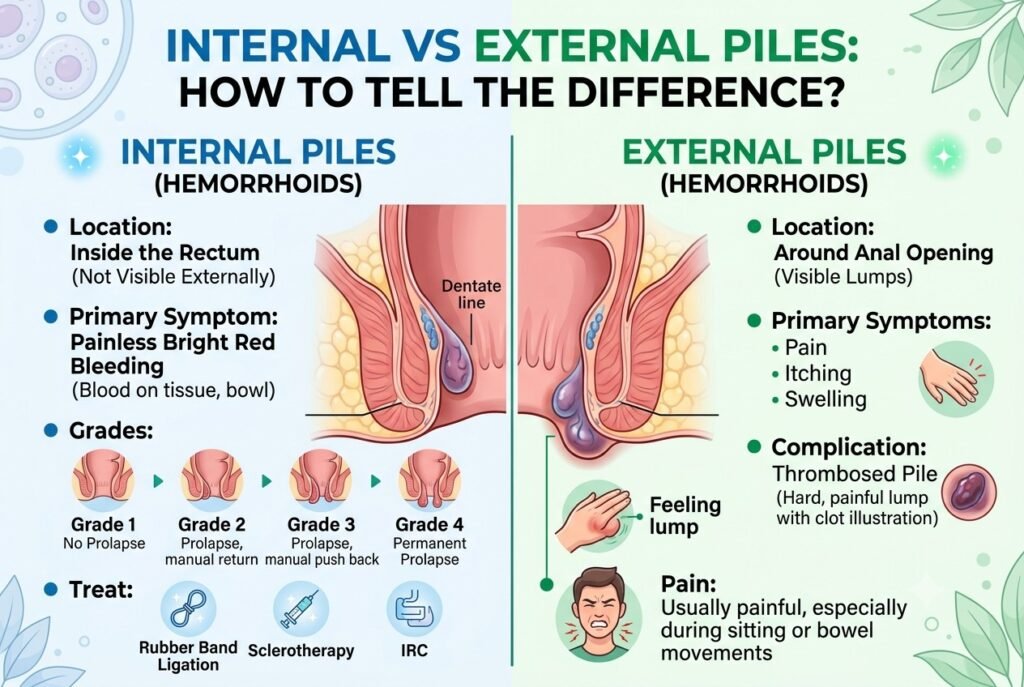
Internal vs External Piles: How to Tell the Difference? Piles medically known as hemorrhoids are one of the most common yet least discussed health concerns. Many people live with the discomfort for months before seeking help, often because they are unsure what type they have or how serious it is. Understanding the difference between internal and external piles is the first step toward getting the right care. What Are Piles and Why Do They Develop? Piles are swollen veins in and around the rectum and anal canal. They develop when increased pressure from chronic constipation, prolonged straining, pregnancy, or a low-fibre diet causes these veins to swell and become inflamed. The Anatomy Behind Piles: The location of the swelling determines the type. Piles that form inside the rectum are called internal piles. Those that develop around the outer anal opening are called external piles. Both share common causes but differ significantly in symptoms, appearance, and treatment approach. Internal Piles – What Happens Inside the Rectum? Internal piles develop within the lining of the rectum and are typically not visible or directly felt in early stages. Symptoms You Feel But Cannot See: The most common sign is painless bright red bleeding during bowel movements. You may notice blood on tissue paper or in the bowl. A feeling of incomplete evacuation or mild discomfort after passing stool is also common. The Four Grades of Internal Piles: Internal piles are classified into four grades based on severity: Grade 1— Small swellings inside the anal canal; no prolapse Grade 2— Prolapse during straining but return on their own Grade 3— Prolapse and require manual pushing back Grade 4— Permanently prolapsed and cannot be pushed back Grade determines which piles treatment option your doctor will recommend. External Piles – What Develops Around the Anal Opening External piles form under the skin around the anal opening and are often visible and painful. Symptoms That Are Visible and Uncomfortable: Unlike internal piles, external piles cause itching, swelling, and pain especially during sitting or bowel movements. In some cases, a hard, tender lump forms when a blood clot develops inside this is called a thrombosed external pile and can be extremely painful, requiring prompt medical attention. Piles Treatment Options – Based on Type and Grade Sr. Feature Internal Piles External Piles 1 Location Inside rectum Around anal opening 2 Pain Usually painless Often painful 3 Bleeding Common Less Common 4 Visibility Not visible Visible as lumps 5 Prolapse Possible in Grade 2–4 Does not prolapse Piles Treatment Options – Based on Type and Grade Treatment is never one-size-fits-all. It depends on the type, grade, and severity of your piles. Non-Surgical Treatments for Mild to Moderate Cases: For Grade 1 and Grade 2 internal piles, non-surgical procedures are usually sufficient: Rubber Band Ligation– A small rubber band is placed around the pile to cut off its blood supply, causing it to shrink and fall off naturally Sclerotherapy– A chemical solution is injected directly into the pile to shrink it IRC (Infrared Coagulation)– Infrared heat is used to coagulate the blood vessels feeding the pile, effectively shrinking it with minimal discomfort Minimally Invasive Surgical Options: For Grade 3 piles or cases that do not respond to non-surgical treatment: Laser Piles Treatment– A precise laser beam closes off the hemorrhoidal tissue with minimal bleeding, faster healing, and significantly less post-operative pain compared to traditional surgery MIPH / Stapler Surgery– A circular stapling device repositions and removes the prolapsed internal pile tissue, restoring normal anatomy with minimal discomfort and quick recovery Conventional Surgery for Advanced Cases Hemorrhoidectomy – Complete surgical removal of the pile tissue. Recommended for Grade 4 internal piles or large, complex external piles that do not respond to other treatments. It has the highest long-term success rate among all surgical options How Does Your Doctor Decide the Right Treatment? Your specialist will consider the grade and type of piles, your symptoms, age, overall health, and personal preferences before recommending a treatment path. Always ask: Which grade are my piles? Is surgery necessary or can we start with a non-surgical option? What is the expected recovery time? Being informed makes a significant difference in the quality of care you receive. Prevention – Keeping Piles from Returning: Regardless of the treatment you choose, these habits protect your long-term rectal health: Eat a high-fibre diet with fruits, vegetables, and whole grains Drink plenty of water daily to keep stools soft Never strain during bowel movements Avoid sitting on the toilet for extended periods Exercise regularly to improve bowel function Final Thoughts – Know Your Type, Get the Right Care Internal and external piles may share the same root cause but they behave differently, feel different, and require different approaches to treatment. Whether your case calls for rubber band ligation, sclerotherapy, laser treatment for piles, stapler surgery, or a hemorrhoidectomy the right diagnosis always comes first. Do not delay speaking to a specialist. The sooner you understand what you are dealing with, the sooner you can put it behind you.

Uncategorized

What Are the Early Signs of Anorectal Problems You Shouldn’t Ignore?

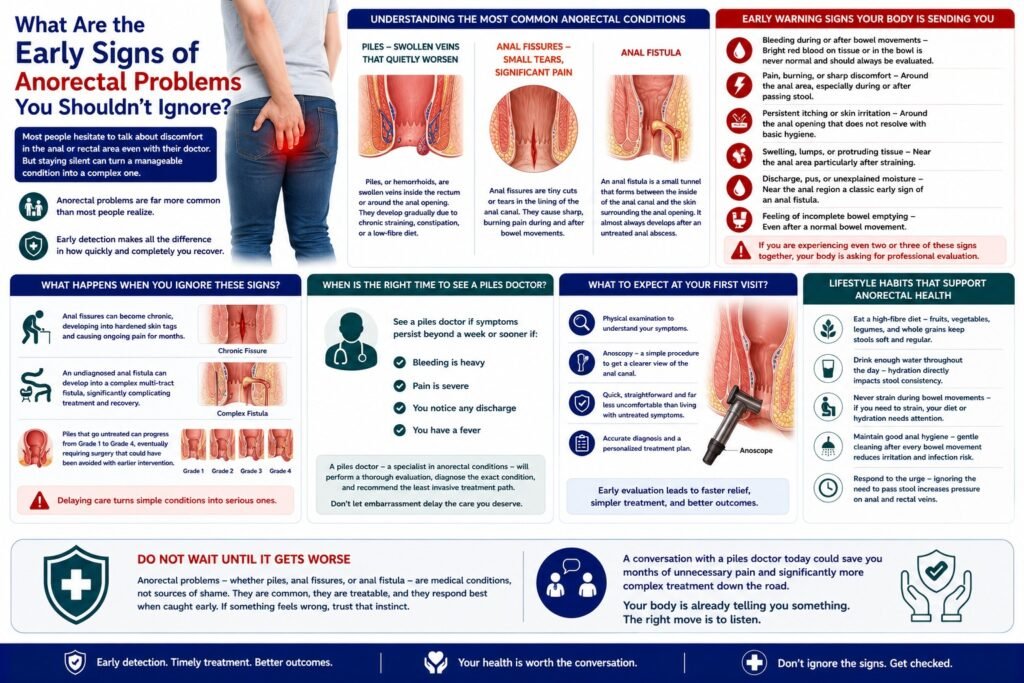
What Are the Early Signs of Anorectal Problems You Shouldn’t Ignore? Most people hesitate to talk about discomfort in the anal or rectal area even with their doctor. But staying silent about these symptoms often turns a manageable condition into a complex one. Anorectal problems are far more common than most people realize, and early detection makes all the difference in how quickly and completely you recover. Why Anorectal Health Deserves More Attention Than It Gets? The discomfort, bleeding, or irritation you keep dismissing as “nothing serious” may be your body signalling something that genuinely needs care. Anorectal conditions rarely resolve on their own without proper treatment and the longer they go unaddressed, the more complicated they become. How Early Detection Changes Everything? Conditions caught in their early stages respond far better to simpler, less invasive treatments. What begins as mild discomfort can escalate into chronic pain, infection, or surgical intervention if left unattended. Understanding the Most Common Anorectal Conditions: Before recognizing the signs, it helps to understand what you may be dealing with. Piles – Swollen Veins That Quietly Worsen Piles, or hemorrhoids, are swollen veins inside the rectum or around the anal opening. They develop gradually due to chronic straining, constipation, or a low-fibre diet. Many people have piles for months before they notice any symptoms. Anal Fissures – Small Tears, Significant Pain Anal fissures are tiny cuts or tears in the lining of the anal canal. Despite their small size, they cause sharp, burning pain during and after bowel movements. They are often triggered by passing hard stools and can become chronic if not treated promptly.     Anal Fistula An anal fistula is a small tunnel that forms between the inside of the anal canal and the skin surrounding the anal opening. It almost always develops after an untreated anal abscess and will not heal without medical intervention. Early Warning Signs Your Body Is Sending You: These are the signs that deserve immediate attention, not tomorrow, not next week: Bleeding during or after bowel movements – bright red blood on tissue or in the bowel, is never normal and should always be evaluated Pain, burning, or sharp discomfort – around the anal area, especially during or after passing stool Persistent itching or skin irritation –  around the anal opening that does not resolve with basic hygiene Swelling, lumps, or protruding tissue – near the anal area, particularly after straining Discharge, pus, or unexplained moisture – near the anal region, is aclassic early sign of an anal fistula Feeling of incomplete bowel emptying – even after a normal bowel movement If you are experiencing even two or three of these signs together, your body is asking for professional evaluation. What Happens When You Ignore These Signs? Delaying care is where simple conditions become serious ones. Untreated anal fissures can become chronic, developing into hardened skin tags and causing ongoing pain for months. An undiagnosed anal fistula can develop into a complex multi-tract fistula, significantly complicating treatment and recovery. Piles that go untreated can progress from Grade 1 to Grade 4, eventually requiring surgery that could have been avoided with earlier intervention. When Is the Right Time to See a Piles Doctor? The right time is as soon as you notice symptoms that persist beyond a week or sooner if the bleeding is heavy, the pain is severe, or you notice any discharge or fever. A piles doctor a specialist in anorectal conditions will perform a thorough evaluation, diagnose the exact condition, and recommend the least invasive treatment path appropriate for your case. Do not let embarrassment delay a consultation that could resolve your problem quickly and completely. What to Expect at Your First Visit? Your specialist will begin with a physical examination and may perform a simple procedure called an anoscopy to get a clearer view of the anal canal. It is a quick, straightforward process and far less uncomfortable than living with untreated symptoms. Lifestyle Habits That Support Anorectal Health Whether you are in recovery or trying to prevent these conditions from developing, these daily habits genuinely help: Eat a high-fibre diet fruits, vegetables, legumes, and whole grains keep stools soft and regular Drink enough water throughout the day hydration directly impacts stool consistency Never strain during bowel movements if you need to strain, your diet or hydration needs attention Maintain good anal hygiene gentle cleaning after every bowel movement reduces irritation and infection risk Respond to the urge ignoring the need to pass stool increases pressure on anal and rectal veins Do Not Wait Until It Gets Worse Anorectal problems whether piles, anal fissures, or anal fistula are medical conditions, not sources of shame. They are common, they are treatable, and they respond best when caught early. If something feels wrong, trust that instinct. A conversation with a piles doctor today could save you months of unnecessary pain and significantly more complex treatment down the road. Your body is already telling you something. The right move is to listen.

Uncategorized

When Should I worry About Blood in my Stool?

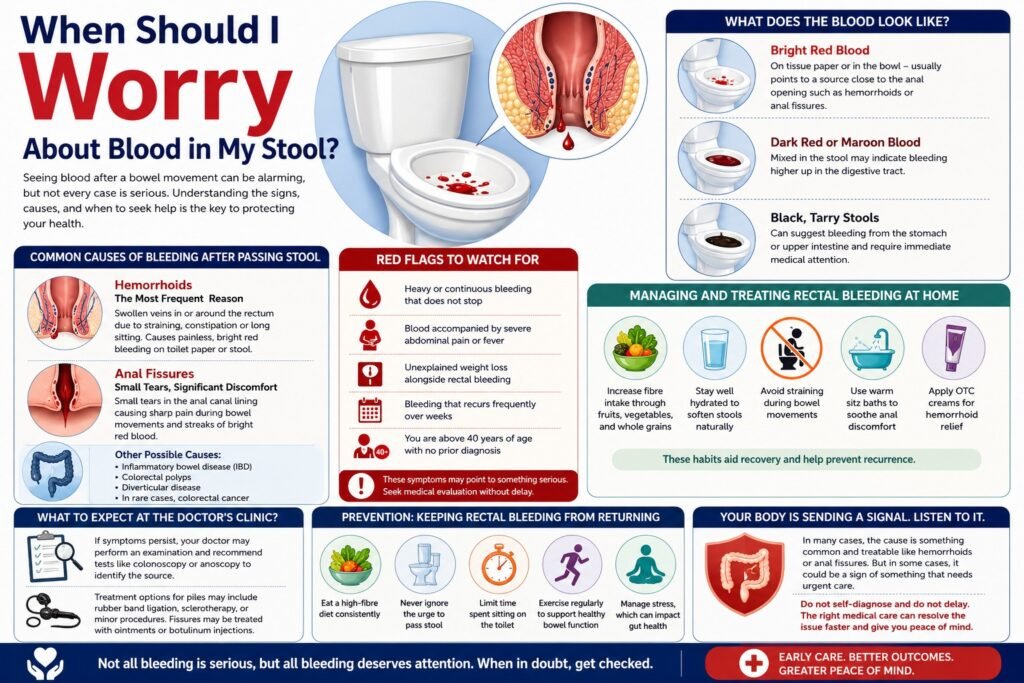
When Should I worry About Blood in my Stool? Seeing blood after a bowel movement can be alarming and understandably so. Your first instinct might be to panic, but the truth is, not every case of rectal bleeding signals something serious. However, ignoring it entirely is never the right move either. Understanding what your body is trying to tell you is the first and most important step. Why Does Bleeding Happen During a Bowel Movement? The rectal and anal area has a rich network of blood vessels. When these vessels experience increased pressure from straining, constipation, or even prolonged sitting they can swell, tear, or rupture, leading to visible bleeding. The two most common reasons behind this are hemorrhoids and anal fissures both of which are more prevalent than most people realize and are highly treatable when caught early. What Does the Blood Look Like? Not all rectal bleeding looks the same, and the appearance can give important clues: Bright red blood– On tissue paper or in the bowl usually points to a source close to the anal opening such as hemorrhoids or anal fissures. Dark red or maroon blood– Mixed in the stool may indicate bleeding higher up in the digestive tract. Black, tarry stools– Can suggest bleeding from the stomach or upper intestine and require immediate medical attention. Paying attention to these details before your doctor’s visit can make diagnosis significantly easier. Common Causes of Bleeding After Passing Stool Hemorrhoids – The Most Frequent Reason Hemorrhoids are swollen veins inside the rectum or around the anal opening. They develop due to excess pressure from straining during bowel movements, chronic constipation, or sitting for long periods. Bleeding from hemorrhoids is typically painless and appears as bright red blood on toilet paper or stool surface. The good news? With the right piles treatment ranging from dietary changes to medical procedures most people recover fully without surgery. Anal Fissures – Small Tears, Significant Discomfort An anal fissure is a small tear in the lining of the anal canal. It usually causes sharp pain during and after bowel movements, along with streaks of bright red blood. Hard or large stools, chronic diarrhea, and low-fibre diets are common triggers. Anal fissures are more common in young adults and infants but can affect anyone. They often heal on their own with simple home care, though persistent cases may need medical treatment. Other Possible Causes: While hemorrhoids and anal fissures account for the majority of cases, other causes include: Inflammatory bowel disease (IBD) Colorectal polyps Diverticular disease In rare cases, colorectal cancer Red Flags to Watch For: Some situations require prompt medical attention. Do not delay seeing a doctor if you notice: Heavy or continuous bleeding that does not stop Blood accompanied by severe abdominal pain or fever Unexplained weight loss alongside rectal bleeding Bleeding that recurs frequently over weeks You are above 40 years of age with no prior diagnosis These symptoms may point to something beyond hemorrhoids or anal fissures and need professional evaluation without delay. Managing and Treating Rectal Bleeding at Home: For mild cases caused by hemorrhoids or anal fissures, these steps can offer significant relief: Increase fibre intake through fruits, vegetables, and whole grains Stay well hydrated to soften stools naturally Avoid straining during bowel movements Use warm sitz baths to soothe anal discomfort Apply over-the-counter creams designed for hemorrhoid relief These habits not only aid recovery but also prevent recurrence. What to Expect at the Doctor’s Clinic? If home remedies do not bring relief within a week or two, a doctor will likely perform a physical examination and may recommend a colonoscopy or anoscopy to identify the source of bleeding. Depending on the diagnosis, piles treatment options may include rubber band ligation, sclerotherapy, or minor surgical procedures. For anal fissures, medicated ointments or botulinum injections are commonly prescribed. Prevention: Keeping Rectal Bleeding from Returning Prevention is always better than cure. Building these habits into your daily routine can protect your rectal health long term: Eat a high-fibre diet consistently Never ignore the urge to pass stool Limit time spent sitting on the toilet Exercise regularly to support healthy bowel function Manage stress, which can directly impact gut health Your Body Is Sending a Signal. Listen to It. Blood after passing stool is something your body is using to get your attention. In many cases, the cause is something as common and manageable as hemorrhoids or anal fissures. But in some cases, it could be a sign of something that needs urgent care. The safest approach? Do not self-diagnose and do not delay. Whether it is a simple lifestyle adjustment or a targeted piles treatment plan, the right medical guidance can resolve the issue faster than you think and give you complete peace of mind.

Uncategorized

Early Detection of Anal Fistula – What Every Patient Should Know

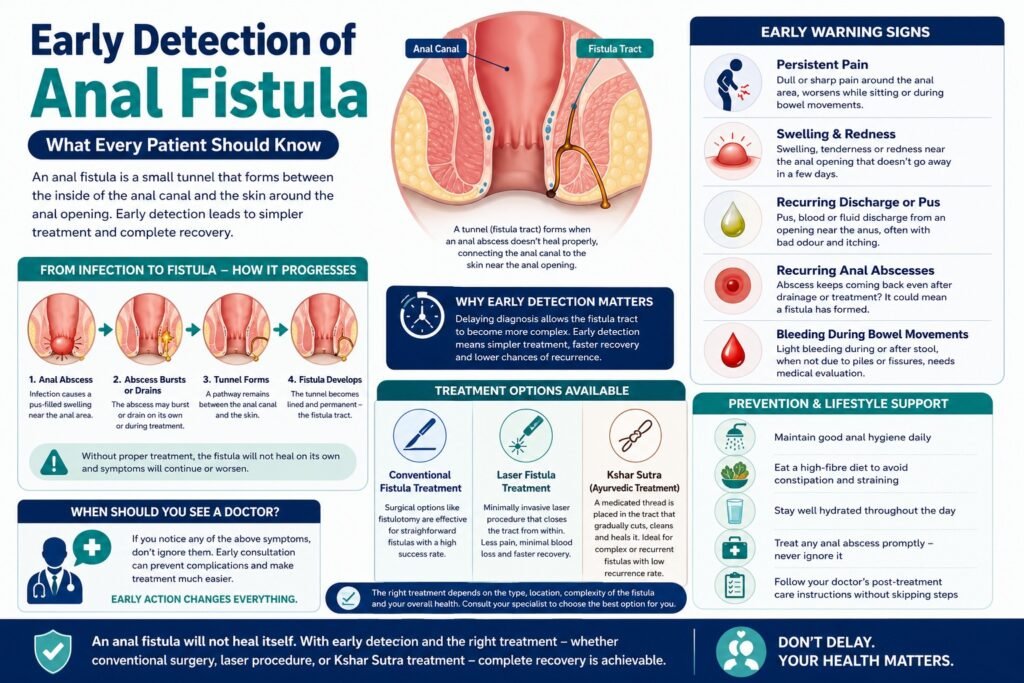
Early Detection of Anal Fistula – What Every Patient Should Know An anal fistula is not something most people talk about openly but it is something many people quietly suffer through, often without realizing what it is. The discomfort, the recurring infections, the unexplained discharge these are not random. They are your body’s way of telling you that something needs attention. And the earlier you listen, the better your chances of a smooth, complete recovery. What Is an Anal Fistula and How Does It Form? An anal fistula is a small tunnel that forms between the inside of the anal canal and the skin around the anal opening. It almost always develops as a result of an anal abscess a painful, pus-filled infection near the anal area. When that abscess does not heal properly or drains on its own without treatment, the tunnel left behind becomes a fistula. From Infection to Fistula How It Progresses The process is gradual. An untreated or poorly treated anal abscess creates a pathway through the tissue. Over time, this pathway becomes lined and permanent forming the fistula tract. Without proper fistula treatment, this tract will not close on its own and will continue to cause symptoms. Early Warning Signs You Should Never Ignore Catching an anal fistula early makes treatment significantly simpler. Here are the signs that deserve your immediate attention: Persistent Pain Around the Anal Area A dull, throbbing, or sharp pain near the anal region especially one that worsens when you sit, move, or pass stool is one of the earliest and most consistent signs of an anal fistula. Swelling and Redness Near the Anal Skin Visible swelling, tenderness, or redness around the anal opening that does not resolve within a few days is a warning sign. Many patients mistake this for a simple skin irritation and delay seeking care. Recurring Discharge or Pus One of the most telling signs of an anal fistula is a persistent or recurring discharge of pus, blood, or fluid from an opening near the anal area. This discharge may have an unpleasant odour and can cause itching or skin irritation around the area. Recurring Anal Abscesses If you have had an anal abscess before and it keeps coming back even after it was drained or treated there is a strong possibility that a fistula has already formed. Recurring abscesses are one of the clearest indicators that something deeper needs to be addressed. Bleeding During Bowel Movements Light bleeding during or after passing stool, when not linked to hemorrhoids or fissures, can sometimes be associated with an anal fistula. Combined with any of the above symptoms, it warrants prompt medical evaluation. Why Early Detection Matters? Delaying diagnosis allows the fistula tract to become more complex. A simple fistula that could have been resolved with a straightforward procedure can evolve into a multi-tract or horseshoe fistula significantly complicating treatment and recovery. Early detection literally determines how easy or difficult your treatment journey will be. Treatment Options Available: The right treatment depends on the type, location, and complexity of the fistula. Here is what modern medicine and traditional practice offer: Conventional Fistula Treatment Surgical options like fistulotomy where the fistula tract is cut open and allowed to heal remain the most widely used approach. It is effective for straightforward fistulas and has a high success rate when performed by an experienced surgeon. Laser Fistula Treatment – Precision With Minimal Downtime Laser fistula treatment is a modern, minimally invasive option that uses laser energy to close and destroy the fistula tract from within. It involves no large incisions, minimal blood loss, and a significantly faster recovery compared to conventional surgery. It is particularly well-suited for patients who want to return to normal life quickly. Kshar Sutra – Ayurvedic Treatment With Centuries of Proof Kshar Sutra treatment is a time-tested ayurvedic procedure where a medicated thread is passed through the fistula tract. The thread slowly cuts, cleans, and heals the tract simultaneously. It is especially recommended for complex or recurrent fistulas and carries a very low recurrence rate. For patients seeking a natural, non-surgical path, ayurvedic treatment through Kshar Sutram offers a reliable and well-documented alternative. Which Treatment Is Right for You? No single treatment fits every patient. Your doctor will evaluate the fistula’s depth, complexity, and your overall health before recommending an approach. Key questions to ask your specialist include: Is my fistula simple or complex? What is the expected recovery time for each option? What are the chances of recurrence with the recommended treatment? Being informed puts you in a stronger position to make the right decision for your body. Prevention and Lifestyle Support During Recovery Whether you are recovering from fistula treatment or trying to prevent recurrence, these habits make a meaningful difference: Maintain good anal hygiene daily Eat a high-fibre diet to avoid constipation and straining Stay well hydrated throughout the day Treat any anal abscess promptly never ignore one hoping it will resolve on its own Follow your doctor’s post-treatment care instructions without skipping steps Early Action Changes Everything An anal fistula will not heal itself. But with early detection and the right treatment whether conventional surgery, laser fistula procedure, or kshar sutra treatment complete recovery is absolutely achievable. The earlier you act, the simpler the path forward. Do not let embarrassment or fear delay care that your body genuinely needs.

Uncategorized

Pregnancy and Piles: The Real Reasons It Happens and Your Complete Guide to Safe Relief

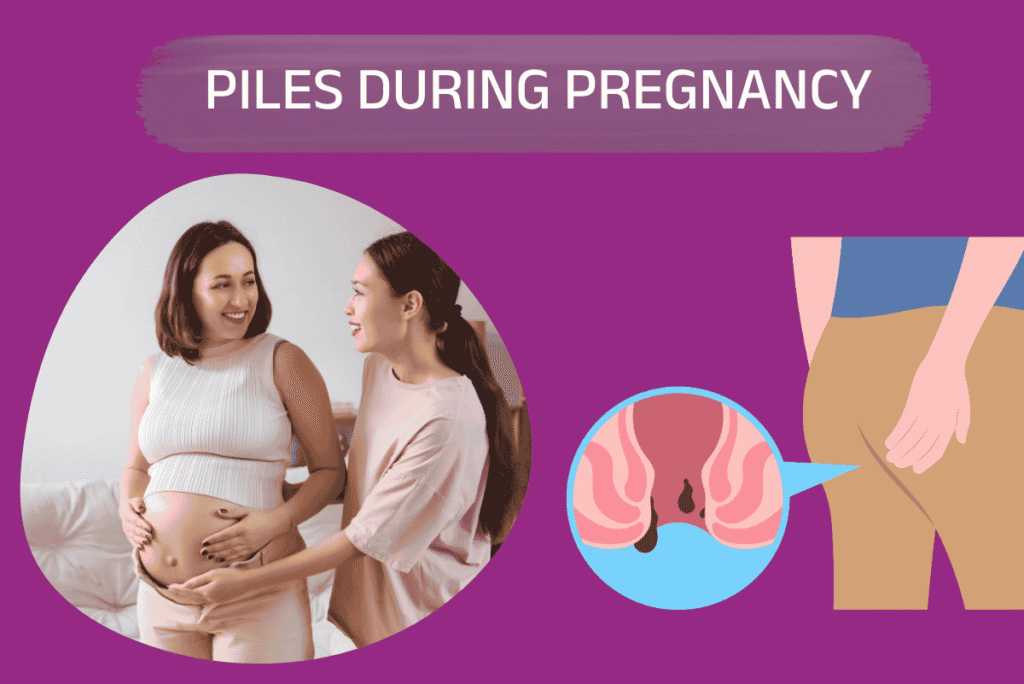
Pregnancy and Piles: The Real Reasons It Happens and Your Complete Guide to Safe Relief Pregnancy brings joy, anticipation and for many women, an uncomfortable surprise: piles. If you’ve noticed itching, swelling, or discomfort around your rectal area during pregnancy, you’re far from alone. Piles (also called haemorrhoids) affect a significant number of expectant mothers, especially in the second and third trimesters. The good news? Understanding why they happen is the first step toward finding real relief. What Are Piles and Why Does Pregnancy Trigger Them? Piles are swollen veins in and around the rectum and anus. Think of them like varicose veins except they develop in a place nobody talks about at the dinner table. Pregnancy creates the perfect storm for piles to develop. As your baby grows, the uterus places increasing pressure on the pelvic veins, slowing blood flow and causing veins in the rectal area to swell. On top of that, the hormone progesterone which surges during pregnancy relaxes the walls of your blood vessels, making them more prone to swelling. Increased blood volume across the body adds further strain. Internal vs External: How They Feel Different Not all piles present the same way. Internal piles form inside the rectum and are often painless, though they may bleed during bowel movements. External piles develop under the skin around the anus and tend to cause itching, soreness, and visible swelling. Some women experience both and pushing during labour can temporarily worsen symptoms. Symptoms You Should Know About Piles during pregnancy commonly cause: Bright red blood on toilet paper after a bowel movement Itching or burning sensation around the anus A feeling of fullness or incomplete bowel emptying Swelling or a lump near the anus Discomfort while sitting for long periods Mild symptoms are manageable at home. However, if bleeding is persistent, pain becomes severe, or you notice hard lumps, consult your doctor promptly these could indicate a thrombosed haemorrhoid or another condition that needs attention. Managing Piles Safely During Pregnancy: Dietary Adjustments That Make a Real Difference Constipation is one of the biggest triggers for piles, and diet plays a central role. Aim for 25-30 grams of fibre per day through fruits, vegetables, whole grains, and legumes. Drink 8-10 glasses of water daily to keep stools soft and passing easily. Avoid processed foods, excess dairy, and caffeine, as these can slow digestion and worsen constipation. Comfort Measures at Home Warm sitz baths sitting in shallow warm water for 10-15 minutes, two to three times a day provide significant relief. Witch hazel pads can soothe inflammation, and applying a wrapped ice pack briefly reduces swelling. Avoid sitting or standing for extended periods, and consider a donut cushion to ease pressure while seated. When Home Care Isn’t Enough: Piles Treatment During Pregnancy? If symptoms persist despite home remedies, your doctor may recommend doctor-approved topical creams, stool softeners, or safe fibre supplements. The goal of any piles treatment during pregnancy is symptom management surgical procedures are generally avoided until after delivery, as most cases improve significantly once the baby is born and hormone levels normalise. After Delivery: Is Laser Treatment for Piles Worth Considering? For women whose piles do not resolve after childbirth, modern medical options offer effective, low-downtime solutions. Laser treatment for piles has become a preferred choice for post-delivery care. It is minimally invasive, requires no large incisions, involves very little bleeding, and typically allows patients to return to normal activities within a day or two. It works by using focused laser energy to shrink and seal the swollen tissue precisely. If you still have symptoms six weeks after delivery, it’s worth discussing laser treatment for piles with a specialist to determine if you’re a suitable candidate. Prevention for Future Pregnancies Once you know the triggers, prevention becomes manageable. Stay physically active with gentle daily walks, maintain a high-fibre diet from the start of pregnancy, respond to toilet urges immediately without straining, and raise the topic early with your gynaecologist if you’ve had piles before. You Don’t Have to Just Put Up With It Piles during pregnancy are common, but suffering in silence is not your only option. From simple dietary tweaks and sitz baths to doctor-guided piles treatment and laser treatment for piles after delivery effective, safe options exist at every stage. The sooner you address symptoms, the more comfortable your pregnancy journey can be. Speak to your healthcare provider without hesitation; this is one of the most frequently asked and most manageable concerns during pregnancy. Frequently Asked Questions Can piles harm my baby during pregnancy? No. Piles affect your comfort but pose no risk to your baby’s health or development. Is laser treatment for piles safe after delivery?  Yes, it is generally considered safe and effective for women who are no longer pregnant or breastfeeding. Always consult your specialist for personalised advice. How soon do piles go away after childbirth? Many women see significant improvement within a few weeks postpartum as hormone levels stabilise and uterine pressure lifts. What foods should I avoid if I have piles while pregnant? Avoid spicy foods, refined grains, excess dairy, caffeine, and processed snacks all of which can contribute to constipation and worsen symptoms.

Uncategorized

Beyond Basic Surgery: Advanced Treatment Options for Complex and Recurrent Anal Fistula

Beyond Basic Surgery: Advanced Treatment Options for Complex and Recurrent Anal Fistula An anal fistula is more than just an inconvenient condition for many patients, it becomes a cycle of pain, infection, and repeated procedures that never seem to fully resolve. If you’ve already had treatment and the fistula has returned, or if your surgeon has described your case as “complex,” you’re not alone. The good news is that fistula treatment has advanced significantly, and today there are targeted, minimally invasive options designed specifically for difficult and recurring cases. What Makes a Fistula “Complex” or “Recurrent”? Not all fistulas are alike. A simple fistula follows a single, straightforward tract and carries a low risk to the surrounding muscles. A complex fistula, on the other hand, may involve multiple branching tracts, pass through or near the sphincter muscles, or be linked to underlying conditions such as Crohn’s disease, diabetes, or a history of pelvic radiation. Understanding Why Some Fistulas Are Harder to Treat The sphincter muscles that control bowel continence run directly through the area where complex fistulas develop. Any treatment that damages these muscles even partially can lead to incontinence. This is why standard fistulotomy, which works well for low, simple fistulas, is not always appropriate here. The higher the fistula tract runs through the sphincter, the greater the surgical challenge. Why Fistulas Come Back After Initial Treatment? Recurrence usually happens for one of three reasons: the internal opening was not fully identified and closed, secondary or hidden tracts were missed during the original procedure, or an underlying inflammatory condition continued to drive new tract formation. This is why accurate diagnosis before choosing a fistula treatment plan is absolutely critical. Why Getting the Diagnosis Right Changes Everything? Before any advanced treatment begins, imaging is essential. MRI of the perianal region gives surgeons a detailed map of the fistula tract its depth, direction, and relationship to the sphincter complex. Endoanal ultrasound adds further precision, particularly for identifying secondary extensions that are invisible during a physical examination. Without this level of detail, even the most skilled surgeon is working partially blind. Advanced Fistula Treatment Options for Complex and Recurring Cases: LIFT Procedure: Closing the Tract Between the Muscles The LIFT procedure is a sphincter-saving technique designed for trans phincteric fistulas. The surgeon accesses the tract in the space between the internal and external sphincter muscles, ties it off, and removes the infected tissue all without cutting through muscle. It carries a good success rate and significantly lowers the risk of incontinence compared to conventional surgery. VAAFT: Seeing Inside the Tract for Greater Precision Video-Assisted Anal Fistula Treatment (VAAFT) uses a miniature camera inserted into the fistula tract, allowing the surgeon to directly visualise the internal opening and any hidden branches. Once identified, the tract is cleaned and sealed under direct vision. This approach is particularly valuable in recurrent cases where previous treatments may have altered the local anatomy, making blind techniques unreliable. Seton Placement: A Staged Strategy for High-Risk Cases Video-Assisted Anal Fistula Treatment (VAAFT) uses a miniature camera inserted into the fistula tract, allowing the surgeon to directly visualise the internal opening and any hidden branches. Once identified, the tract is cleaned and sealed under direct vision. This approach is particularly valuable in recurrent cases where previous treatments may have altered the local anatomy, making blind techniques unreliable. LIFT Procedure: Closing the Tract Between the Muscles When a fistula runs high through the sphincter and the risk to continence is significant, a seton a fine surgical thread is passed through the tract and left in place for several weeks. This gradually cuts through or simply marks the tract, allowing staged fistula treatment while minimising the risk of sudden sphincter damage. It is often used as a first step before a definitive procedure. Why Laser Fistula Treatment Is Becoming the Preferred Choice Among all the options available today, laser fistula treatment has gained considerable attention and for good reason. A thin laser fibre is inserted directly into the fistula tract and activated, delivering precise energy that destroys the tract lining and causes it to seal from the inside out. No large incisions, no cutting of muscle, and no open wound to manage afterward. What Sets Laser Fistula Treatment Apart The benefits go beyond comfort. Laser fistula treatment causes minimal bleeding, involves very little postoperative pain, and allows most patients to resume normal daily activities within two to three days. Crucially, it preserves sphincter function a major concern in complex cases and can be repeated if necessary without significantly affecting surrounding tissue. Is Laser the Right Option for Every Patient? Laser works best for fistulas with a single, well-defined tract. For very extensive or highly branched fistulas, it may be combined with another technique such as VAAFT or LIFT for optimal results. A thorough specialist evaluation including MRI will determine whether laser alone is sufficient or whether a combined approach offers the best long-term outcome. Recovery and Reducing the Risk of Recurrence Recovery from advanced fistula procedures is generally much smoother than after open surgery. Most patients experience mild discomfort for a few days, manageable with basic pain relief. Regular sitz baths, a high-fibre diet, and staying well hydrated help the healing process. Equally important is follow-up attending post-treatment reviews allows your surgeon to catch any early signs of recurrence and address them before a full relapse occurs. Warning Signs You Should Never Ignore If you notice persistent discharge near the anus, a wound that refuses to heal, recurrent swelling or abscess formation, or ongoing pain despite previous treatment these are signals that the fistula has either returned or was never fully resolved. Early specialist review gives you the widest range of treatment options and the best chance of a lasting cure. The Right Approach Makes All the Difference Complex and recurrent fistulas deserve more than a repeated attempt at the same procedure. With advanced options including LIFT, VAAFT, seton placement, and laser fistula treatment, patients today have access to precise, sphincter-preserving solutions that address

Scroll to Top